
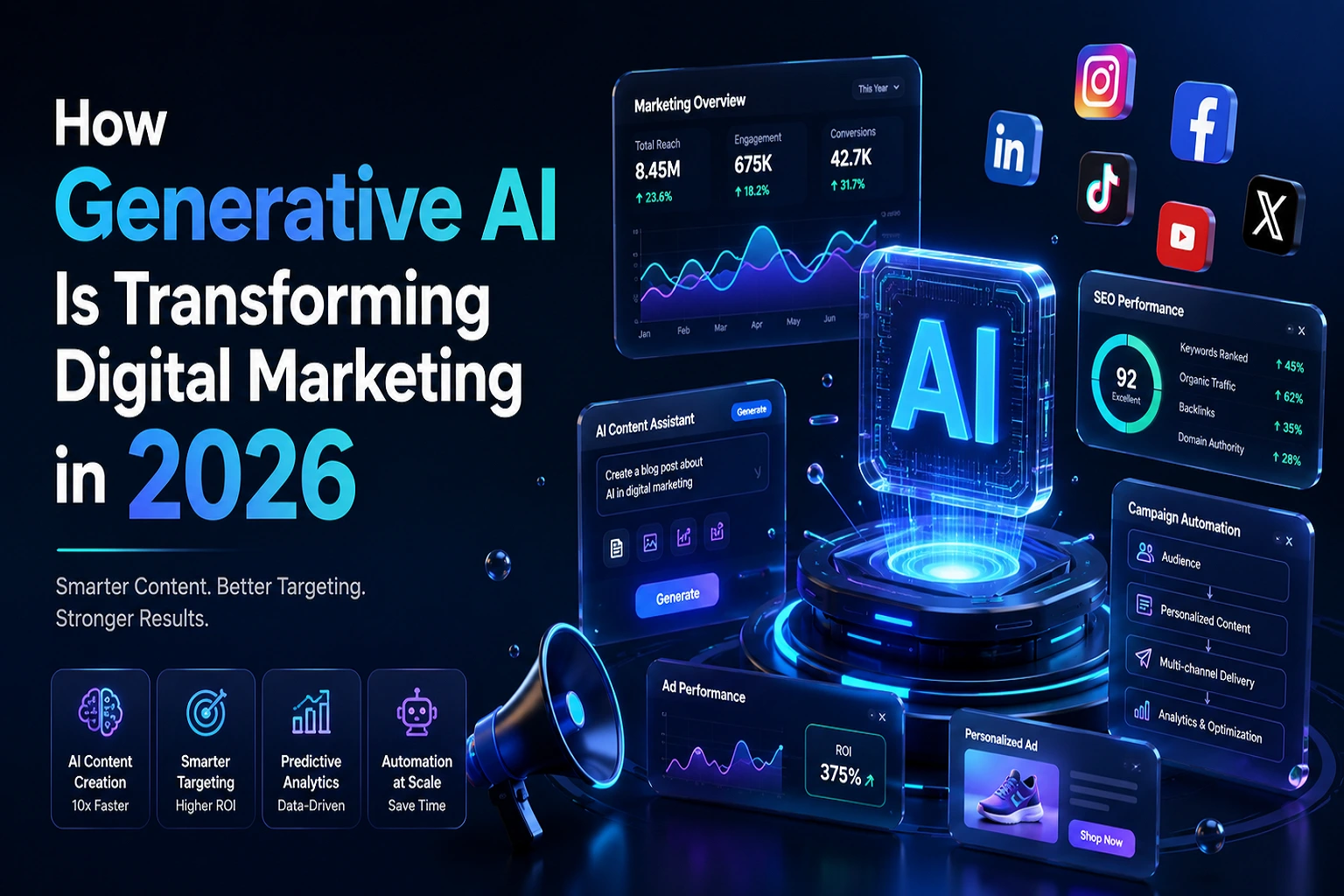
In 2026, Generative AI is no longer just a futuristic technology — it has become one of the most important tools in digital marketing. From content creation and ad design to customer behavior analysis and campaign personalization, companies around the world are using AI to increase speed, reduce costs, and improve audience engagement.
With the rise of advanced AI models such as OpenAI’s ChatGPT, Google Gemini, Claude, and Midjourney, businesses can now create content faster, smarter, and more efficiently than ever before. However, alongside all these advantages, this transformation also brings serious challenges — especially when it comes to content quality, trust, and authenticity.
In this article, we will explore how Generative AI is transforming digital marketing in 2026, which tools are the most popular, what the benefits and risks are, how AI improves productivity, and why humanized content still matters.
What Is Generative AI?
Generative AI refers to systems that can create text, images, videos, audio, and even code. Unlike traditional AI, which mainly analyzes data, Generative AI can produce entirely new and creative content.
For example, AI can:
- Write blog articles
- Generate social media captions
- Design advertising visuals
- Create marketing emails
- Produce short promotional videos
- Power intelligent chatbots
These capabilities have made AI a core part of modern marketing strategies.
How Companies Use AI in Digital Marketing
Today, both large and small businesses use AI to automate and optimize marketing processes. One of the most common applications is content creation. Brands can now generate articles, ads, emails, and social media posts within minutes.
Many e-commerce companies also use AI to personalize the customer experience. Intelligent algorithms analyze user behavior and recommend products that customers are more likely to purchase.
In digital advertising, AI plays a major role by helping companies:
- Identify the best time to publish ads
- Analyze target audiences
- Optimize ad copy
- Improve conversion rates
In addition, AI-powered chatbots are widely used for customer support. These systems can respond to users 24/7 and create a faster, smoother customer experience.
The Most Popular AI Tools in 2026
In 2026, a wide variety of AI tools are being used in marketing, each serving different purposes.
ChatGPT
One of the most popular AI tools for writing articles, marketing copy, emails, and customer responses.
Gemini
A powerful AI model developed by Google with strong capabilities in search, data analysis, and content generation.
Midjourney
An advanced AI image-generation tool widely used for creating advertising visuals and creative designs.
Canva AI
A design platform that helps users quickly create banners, social media graphics, and visual marketing content.
Jasper AI
A specialized AI writing tool focused on SEO and marketing content production.
Synthesia
An AI video-generation platform that creates professional videos using AI avatars.
These tools allow even small teams to run highly professional marketing campaigns with fewer resources.
Benefits of Using AI in Digital Marketing
Generative AI offers many advantages for businesses, especially in terms of speed and efficiency.
1. Faster Content Creation
Tasks that once required hours can now be completed in minutes. AI can quickly generate drafts for articles, advertisements, and emails.
2. Reduced Costs
Many companies use AI to lower expenses related to content production, design, and customer support.
3. Better Personalization
AI can analyze customer behavior and create more personalized experiences for each user.
4. Advanced Data Analysis
AI tools process large amounts of data and help businesses make smarter marketing decisions.
5. Higher Conversion Rates
AI-powered advertising campaigns are often more targeted and effective than traditional marketing methods.
Risks and Challenges of AI in Marketing
Despite its advantages, AI also comes with several important risks.
Low-Quality or Repetitive Content
Many brands focus too heavily on mass-producing content. As a result, the internet is becoming crowded with generic and repetitive articles.
Incorrect Information
AI systems sometimes generate inaccurate or outdated information, which can damage a company’s credibility.
Loss of Audience Trust
If users feel that content is completely machine-generated, they may trust the brand less.
Copyright and Legal Concerns
AI-generated images and written materials may create legal challenges related to ownership and copyright.
Overdependence on Automation
Some companies rely too heavily on AI and ignore the value of human creativity and strategic thinking.
How AI Improves Productivity
One of the biggest reasons behind AI’s popularity is its ability to dramatically improve productivity. Marketing teams can now accomplish tasks that previously required multiple employees.
For example, AI can help teams:
- Generate multiple ad variations within minutes
- Schedule social media posts automatically
- Analyze campaign performance instantly
- Respond to customer inquiries automatically
- Produce visual and video content much faster
As a result, marketing professionals can spend more time on creativity, strategy, and brand development rather than repetitive tasks.
Why Humanized Content Still Matters
Despite the rapid advancement of AI, human-created content still holds enormous value. Modern audiences can often recognize the difference between authentic human communication and purely machine-generated writing.
Humanized content includes qualities that AI still struggles to replicate perfectly:
- Genuine emotions
- Personal experiences
- Deep creativity
- Natural humor
- Cultural understanding
Search engines like Google also continue to prioritize helpful, trustworthy, and people-focused content. Brands that rely entirely on AI may eventually experience declining quality and reduced audience trust.
The most effective strategy in 2026 is combining AI efficiency with human creativity. AI can increase speed and productivity, but humans remain responsible for authenticity, emotional connection, and originality.
The Future of Digital Marketing with AI
The future of digital marketing is undeniably connected to AI. In the coming years, businesses will see smarter advertising systems, more personalized customer experiences, and even greater automation.
However, the most successful brands will be those that balance technology with human creativity. AI is an incredibly powerful tool, but it is not a complete replacement for human thinking, emotion, and communication.
Ultimately, successful marketing in 2026 is not simply about using AI — it is about using AI intelligently while maintaining the human touch that audiences still value most.
Read the Swedish version here.