
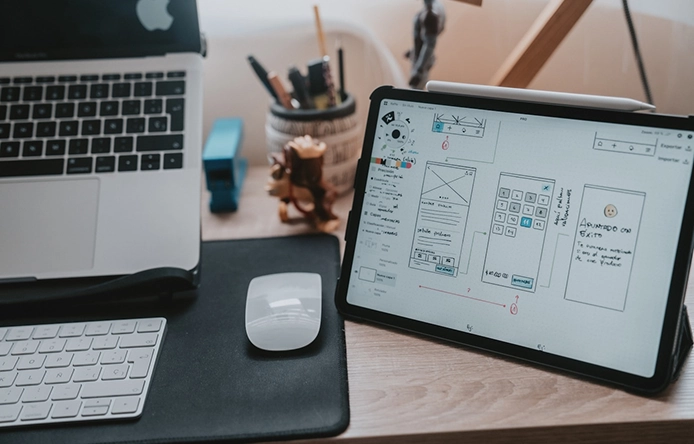
In this article, you will learn what UI and UX mean, the main differences between them, and get useful advice about UI/UX design courses and learning paths.
With the fast development of technology, more and more people are joining the design sphere. Understanding the difference between UX and UI design is of prime importance for the newcomers. A good theoretical basis is the first step toward becoming a professional UX or UI designer.
What is User Experience Design?
User experience design is a process of relationship creation among the company, products, and customers.
UX design is the research, development, and enhancement of all product aspects that deal with user engagement to create satisfaction; in other words, it is done to improve the user’s experience through testing results and ultimately create a useful, valuable, accessible, and fun product.
UX design helps a product deliver on an effective user experience by involving multiple disciplines like visual design, interaction design, and usability, among others.
What is User Interface Design?
User Interface, or UI, design, includes everything visual in a product. It is about how the UI designer envisions a product’s interface to look and function in order to ensure a smooth and pleasant experience for the users.
Good UI design not only attracts end-users but ensures they have a delightful experience with the product.
The elements involve content such as documents, text, images, videos, and forms like buttons, labels, text fields, checkboxes, dropdown menus, layouts, graphics, and interactivity behaviors such as clicks, drags, or inputs.
The UI designer, therefore, needs both an aesthetic vision and a technical one. They have to make sure the interfaces are beautiful, harmonious, and connect with the user on an emotional level.
Think of it this way: if you go to a website and it really catches your eye, that’s the UI designer’s work.
Difference Between UX and UI
While UX and UI often overlap, they possess different roles altogether.
Simply put:
UX design is about the user’s overall experience of a product.
UI design is what provides the look and feel of that product.
Where UI is about how things look, UX is about how things work. UX is process; UI is the deliverable result of that process.
Without UX, UI would be like splashing paint on a canvas without any plan. UX without UI is a skeleton without skin. Both are important to the betterment of your product.
1. Different Focus
The key difference between UX and UI designers lies in the focus while prototyping.
UI designers prefer to make use of high-fidelity prototypes with detailed visuals. UX designers, on the other hand, focus on structure and logic rather than aesthetics.
A UI designer presents a polished visual mockup when presenting to clients. A UX designer shows wireframes and interaction flows when discussing with developers.
The UI designer is interested in the front end, while the UX designer focuses on the back-end logic of interaction.
2. Use of Color
UI designers typically design using a full-color approach. UX designers usually keep it very minimal, designing with black, white, and gray.
For example, when designing a navigation bar, a UI designer will spend time perfecting colors and button states before and after a click. A UX designer will place a button in the correct spot and add a note that says, “button turns gray after click.”
3. Tools Used
UX and UI designers use different tools because of their different roles:
UI designers focus on image creation and animation tools like Figma, Sketch, Flinto, Principle, and InVision, which further tune the look and feel of the product, enhancing collaboration within the teams.
UX designers focus on wireframing and prototyping tools to improve efficiency and test user flows. Common tools include Balsamiq, Axure, and Mockplus.
“Design is not just what it looks like and feels like. Design is how it works.” — Steve Jobs
In theory, UX design encompasses wireframing, prototyping, interaction design, and user testing.
UI design focuses on visual and interaction design.
In particular, both disciplines require a good understanding of interaction design because user emotions and behavior are greatly shaped by the response a product gives to them.
UX Design is done before UI Design.
UX design happens across products, interfaces, and services, while UI design specifically deals with interfaces.
What is actually done by UX and UI Designers?
To understand what UX and UI designers do, it’s good to take a look at their responsibilities.
Key Responsibilities of a UX Designer
- Strategy and Content: User research, competitor analysis, product structure, and strategy.
- Prototyping & Wireframing: Creating wireframes, testing, iteration, and planning.
- Analysis and Implementation: Liaising with the UI designers, studying feedback, and refining designs.
UX designers are responsible not only for planning and supporting the technology behind a product, but for how users interact with it online and offline, including customer service experiences.
Key Responsibilities of a UI Designer
Responsiveness and Interaction: Modifying layout for different screen sizes, animations, and performance of UI.
UI designers create the face of the product by building the brand identity, connecting the product to its users, and establishing trust. This involves close collaboration with UX designers and developers.
What Kind of UX/UI Course Should You Take?
The best and fastest way to learn how to become a UX or UI designer is to take courses for beginners. There are no shortcuts; structured learning is required.
You can find free and paid courses online. Free university courses are a good starting point but might not be enough to build a professional career. Many organizations now offer comprehensive online UX/UI training programs that suit different skill levels.
How Much Do UX and UI Designers Make?
The salary of UX and UI designers is pegged on a number of variables, including location, experience, industry type, and project type.
Generally, a UI designer earns more than a UX designer.
For example, the average annual salary for a UI designer in the United States is around $80,000, while the average for a UX designer is about $60,000.
Salaries vary widely around the world, but both roles are among the most in-demand and best-compensated jobs in the tech industry.
Should You Become a UX or UI Designer?
Every day, designers are making decisions on the path to follow. It’s your turn now to decide whether to focus on the user’s experience or user interface after comprehending the difference between UX and UI design, how they work, and where to learn each skill. Both are creative, analytical roles, and both are integral in creating the way in which people experience technology.