
Search engines are no longer what they used to be. A few years ago, users would type a query into Google, browse through ten blue links, and choose one of them. Today, Google increasingly provides direct AI-generated answers before users even click on a website.
This shift has changed the future of SEO.
Now, brands and content creators are not only trying to rank on the first page of Google, but also trying to become one of the trusted sources used inside Google’s AI-generated answers, AI Overviews, and generative search experiences.
This is where concepts like AI SEO, AEO (Answer Engine Optimization), and GEO (Generative Engine Optimization) become important.
In this guide, you’ll learn exactly what Google AI Answers are, why they matter, and how to optimize your content so Google’s AI is more likely to reference, summarize, and recommend your website.
What Are Google AI Answers?
Google AI Answers are AI-generated summaries that appear directly inside search results. Instead of showing only links, Google now uses artificial intelligence to generate concise answers based on information gathered from multiple websites.
For example, if someone searches:
“Best beginner-friendly investment strategies”
Google may instantly generate a summarized response explaining:
- Index funds
- Dollar-cost averaging
- Diversification
- Long-term investing
Below that summary, Google often displays the websites used as sources.
The goal is simple: provide users with faster and more complete answers without requiring them to visit multiple pages.
For website owners, this creates both a challenge and an opportunity.
If your content is optimized correctly, your website can become one of those cited sources.
Why AI SEO Matters More Than Traditional SEO
Why AI SEO Matters More Than Traditional SEO
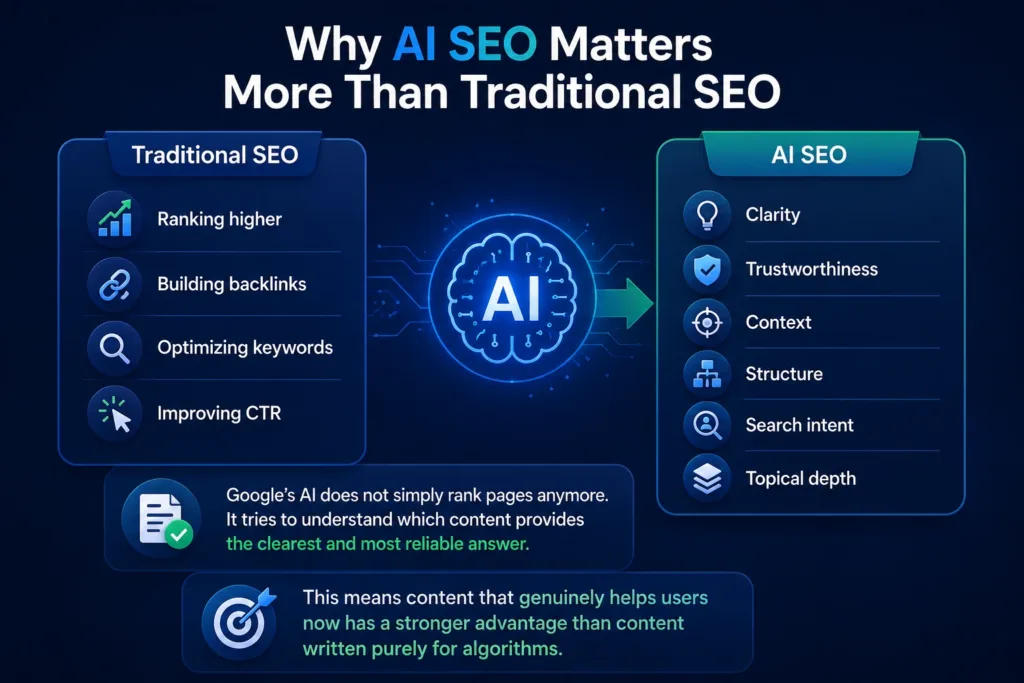
Traditional SEO focused heavily on:
- Ranking higher
- Building backlinks
- Optimizing keywords
- Improving CTR
AI SEO still includes those elements, but the focus has shifted toward:
- Clarity
- Trustworthiness
- Context
- Structure
- Search intent
- Topical depth
Google’s AI does not simply rank pages anymore. It tries to understand which content provides the clearest and most reliable answer.
This means content that genuinely helps users now has a stronger advantage than content written purely for algorithms.
How Google’s AI Chooses Content
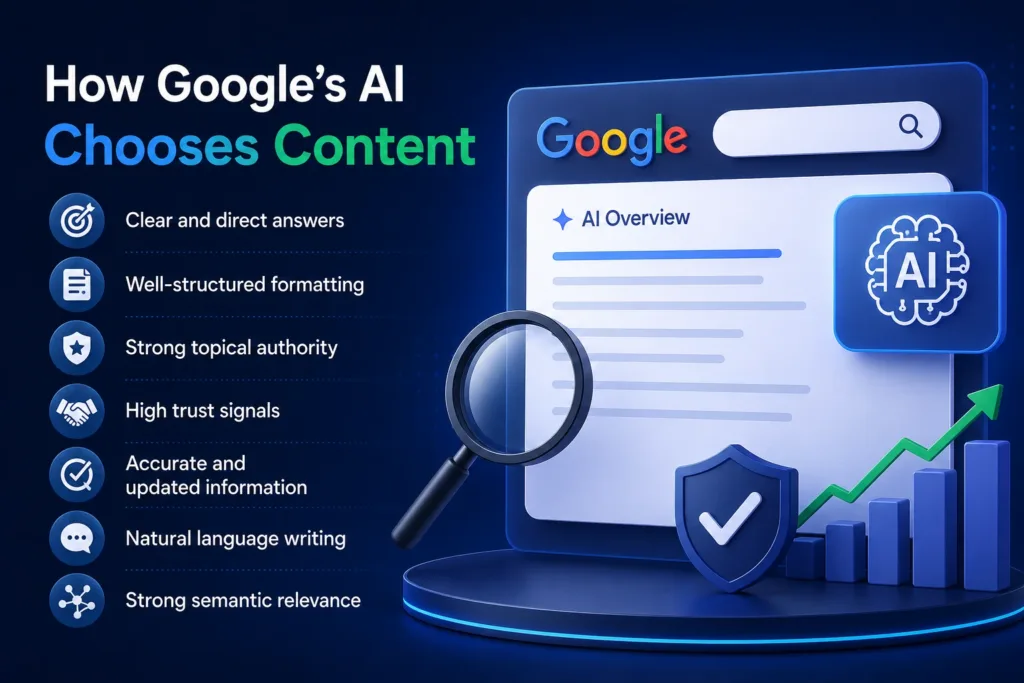
Although Google has not fully revealed how AI Overviews work internally, successful websites usually share several common characteristics:
- Clear and direct answers
- Well-structured formatting
- Strong topical authority
- High trust signals
- Accurate and updated information
- Natural language writing
- Strong semantic relevance
In other words, Google’s AI prefers content that is easy to understand, easy to extract, and genuinely useful.
1. Answer Questions Immediately
One of the biggest mistakes in old-school blogging was writing long introductions before answering the actual question.
AI systems dislike unnecessary fluff.
Instead of writing this:
❌
“Since ancient times, humans have searched for ways to improve productivity…”
Write this:
✅
“The best productivity methods include time blocking, the Pomodoro technique, task batching, and prioritization systems.”
Direct answers help Google extract your content faster.
A strong structure often looks like this:
- Direct answer
- Brief explanation
- Detailed breakdown
- Examples
- FAQs
This format works extremely well for AI-generated search experiences.
2. Optimize for Search Intent, Not Just Keywords
Many websites still obsess over repeating exact keywords multiple times.
That approach is becoming outdated.
Google’s AI understands meaning, context, and user intent better than ever.
For example, if someone searches:
“How to start freelancing”
The AI expects content covering:
- Choosing a niche
- Building a portfolio
- Finding clients
- Pricing services
- Payment methods
- Contracts
- Scaling income
If your article only repeats “start freelancing” twenty times without covering related concepts, it will likely underperform.
Modern SEO is about topical completeness.
3. Use Clean Structure and Formatting
AI systems love organized content because it is easier to scan and summarize.
Your articles should include:
- Clear H1, H2, and H3 headings
- Bullet points
- Numbered lists
- Tables when necessary
- FAQ sections
- Short paragraphs
- Logical flow
Large walls of text reduce readability for both users and AI systems.
Good formatting improves:
- User experience
- Featured snippet opportunities
- AI extraction quality
- Engagement metrics
4. Build Topical Authority
Publishing random articles about unrelated topics no longer works as effectively as before.
Google increasingly rewards websites that demonstrate deep expertise within a specific niche.
For example:
A website consistently publishing high-quality content about:
- Technical SEO
- Content strategy
- AI search
- Google updates
- Semantic SEO
will likely become more authoritative in Google’s eyes than a general blog covering dozens of unrelated subjects.
This is called topical authority.
The more comprehensive your ecosystem of content becomes, the more likely Google AI will trust your website as a reliable source.
5. Focus on E-E-A-T
Google strongly emphasizes E-E-A-T:
- Experience
- Expertise
- Authoritativeness
- Trustworthiness
This is especially important in AI-generated answers because misinformation is a major concern.
To improve E-E-A-T:
- Use real author profiles
- Add credible references
- Show practical experience
- Keep information updated
- Include original insights
- Avoid misleading claims
If you operate in sensitive industries like finance, health, or law, trust signals become even more critical.
6. Write Like a Human
Ironically, as AI-generated content increases, human-sounding content becomes more valuable.
Many AI-written articles feel robotic because they:
- Overuse generic phrases
- Lack personality
- Repeat information
- Sound overly formal
Humanized content performs better because it feels authentic and relatable.
Good content should sound like:
- A knowledgeable expert
- Explaining something clearly
- To a real person
Use:
- Natural transitions
- Real examples
- Conversational flow
- Clear explanations
Avoid:
- Keyword stuffing
- Overcomplicated language
- Generic filler text
7. Add FAQ Sections
FAQ sections are extremely powerful for AI SEO.
Why?
Because they directly mirror how users search.
People naturally ask questions like:
- What is AI SEO?
- How does Google AI Overview work?
- Is traditional SEO still important?
- How do I optimize content for AI search?
Answering these questions clearly increases your chances of appearing in:
- Featured snippets
- Voice search
- AI-generated summaries
8. Use Semantic SEO
Semantic SEO means covering an entire topic ecosystem instead of focusing on one isolated keyword.
For example, if your article targets:
“Email marketing”
You should naturally discuss related concepts like:
- Open rates
- Deliverability
- Subject lines
- Segmentation
- Automation
- CTR
- Spam filters
- Personalization
Google’s AI connects these relationships automatically.
The deeper your contextual relevance, the stronger your content becomes.
9. Update Content Regularly
Freshness matters.
Google prefers updated information, especially in fast-changing industries like:
- AI
- SEO
- Technology
- Finance
- Marketing
Outdated articles gradually lose trust and relevance.
Regularly updating:
- Statistics
- Screenshots
- Strategies
- Examples
- Tools
- Search trends
can significantly improve long-term visibility.
10. Prioritize User Experience
AI optimization is not only about content.
Technical performance still matters.
Important factors include:
- Fast loading speed
- Mobile optimization
- Clean design
- Secure HTTPS connection
- Good Core Web Vitals
- Easy navigation
If users quickly leave your website because of poor experience, Google notices those signals.
Helpful content combined with strong UX creates the best long-term results.
The Future of SEO Is AI-Centric
SEO is not disappearing.
It is evolving.
Instead of optimizing purely for rankings, websites now need to optimize for:
- Understanding
- Extraction
- Trust
- Context
- User satisfaction
The websites that succeed in the next generation of search will not necessarily be the ones with the most keywords.
They will be the ones that:
- Answer questions clearly
- Build authority
- Provide real value
- Create trustworthy content
- Understand user intent deeply
Google’s AI is ultimately trying to imitate human judgment.
So the best strategy is surprisingly simple:
Create content that genuinely deserves to be recommended.
That is the real future of AI SEO.
Read the Swedish version here.